
October 9, 2026

Amazon SEO Strategy: The Complete Guide For 2026

Strategy

The practical shift in Amazon SEO over the past two years is not about keywords disappearing. It is about how retrieval, conversion, operational execution, and AI-readable listing data now interact. A listing that ranks in 2026 wins on four fronts at once: it matches what shoppers type, it converts the traffic it receives, it keeps operational metrics clean, and it carries structured data that AI assistants like Alexa for Shopping can read. This guide covers how Amazon's algorithm has evolved, how to research keywords by intent, how to optimize every listing element, and how to build a repeatable audit process. Whether you manage one ASIN or a full catalog, you will leave with a checklist you can run this week.

Table of Contents

  1. What Amazon SEO means in 2026 (and how it differs from Google SEO)
  2. How Amazon's ranking algorithm works now: A9, A10, COSMO, and AI
  3. Intent-driven keyword research for Amazon listings
  4. Optimizing every element of a product listing
    • Product title
    • Bullet points
    • Product description and A+ Content
    • Backend search terms
    • Attributes and category fields
  5. Images and A+ Content: visual assets that drive conversion
  6. Performance signals that decide rankings: reviews, price, inventory, and fulfillment
  7. Using Amazon PPC and external traffic to grow organic rank
  8. Conversion rate optimization and A/B testing on Amazon
  9. An Amazon SEO checklist for tracking, auditing, and improving
  10. Common Amazon SEO mistakes to avoid
  11. What Rufus and Alexa for Shopping mean for the future of Amazon SEO
  12. Frequently asked questions about Amazon SEO
    • How does Amazon SEO work?
    • What is the difference between Amazon SEO and Google SEO?
    • How long does Amazon SEO take to work?
    • Does Amazon PPC help organic rankings?
    • What is a good conversion rate on Amazon?
  13. Get an expert-led Amazon growth plan from Algofy

What Amazon SEO means in 2026 (and how it differs from Google SEO)

Amazon SEO is the practice of optimizing product listings so they rank higher in Amazon's search results and recommendation surfaces. The goal is sales, not clicks or traffic.

The scale of the opportunity is large. Amazon does not publish its total search volume, and third-party estimates vary widely, but it is where a large share of U.S. shoppers start their product searches.

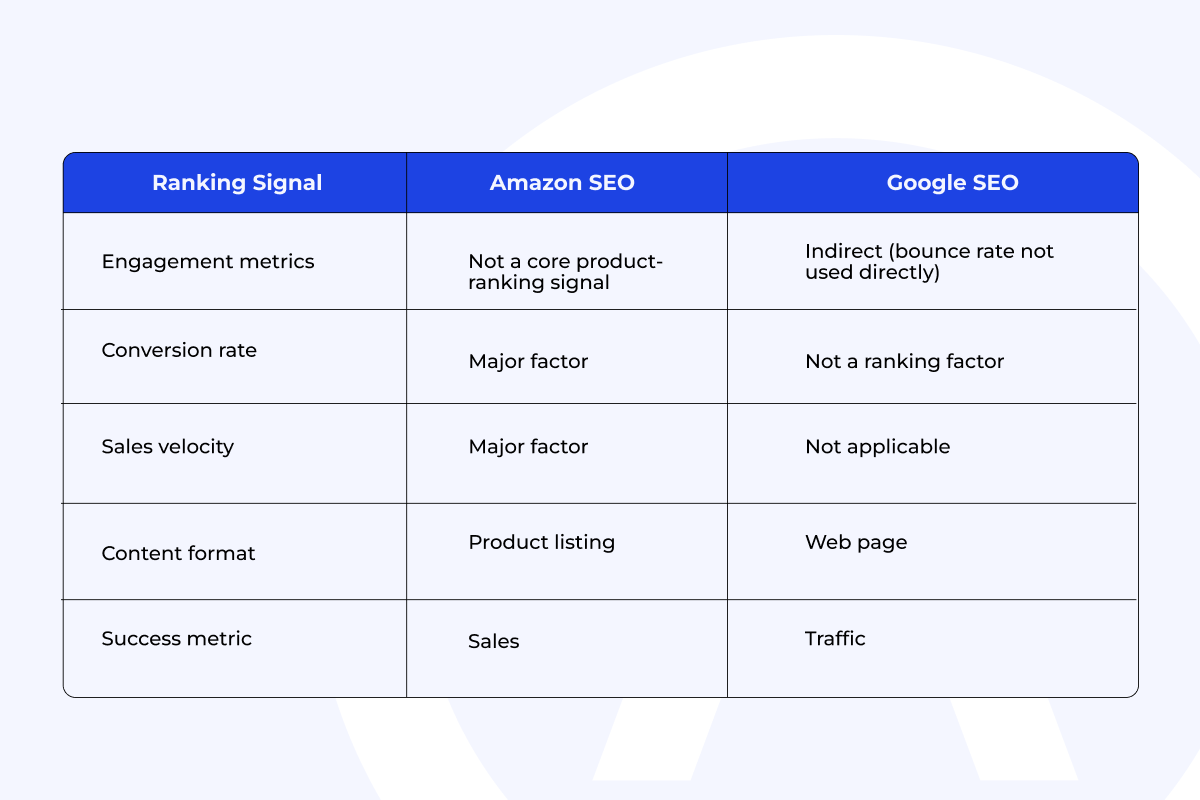
The core difference from Google SEO is simple. Amazon's algorithm ranks products by how likely they are to sell. It does not consider backlinks, time-on-page, or bounce rate. Google focuses on relevance and authority; Amazon optimizes for conversion and sales velocity. On where shoppers start product searches, survey figures range from more than half of consumers (Jungle Scout) to 90% of Amazon customers (CIRP), depending on methodology.

In 2026, Amazon SEO spans more than keyword placement. It covers structured listing data, conversion performance, external traffic, seller authority, and AI-driven discovery through tools like Alexa for Shopping. An effective strategy treats all of these as connected parts of one growth system. Many listings never reach page one for their primary keyword, and that gap is the structural advantage for sellers who adapt to the current algorithm.
How Amazon's ranking algorithm works now: A9, A10, COSMO, and AI

Amazon's product search algorithm, known as A9, has been the foundation of its search since the A9.com subsidiary. Amazon's own seller guidance says listing quality, competitive pricing, and account health can contribute to search rankings, and sellers consistently observe that better-selling products tend toward the beginning of results.

Since late 2024, sellers have observed ranking changes consistent with what the community calls "A10." Amazon has never officially announced an A10 algorithm and does not publish its ranking formula. What sellers report: more weight on organic sales, external traffic, seller authority, and click-through rate, with less direct influence from aggressive PPC spend.
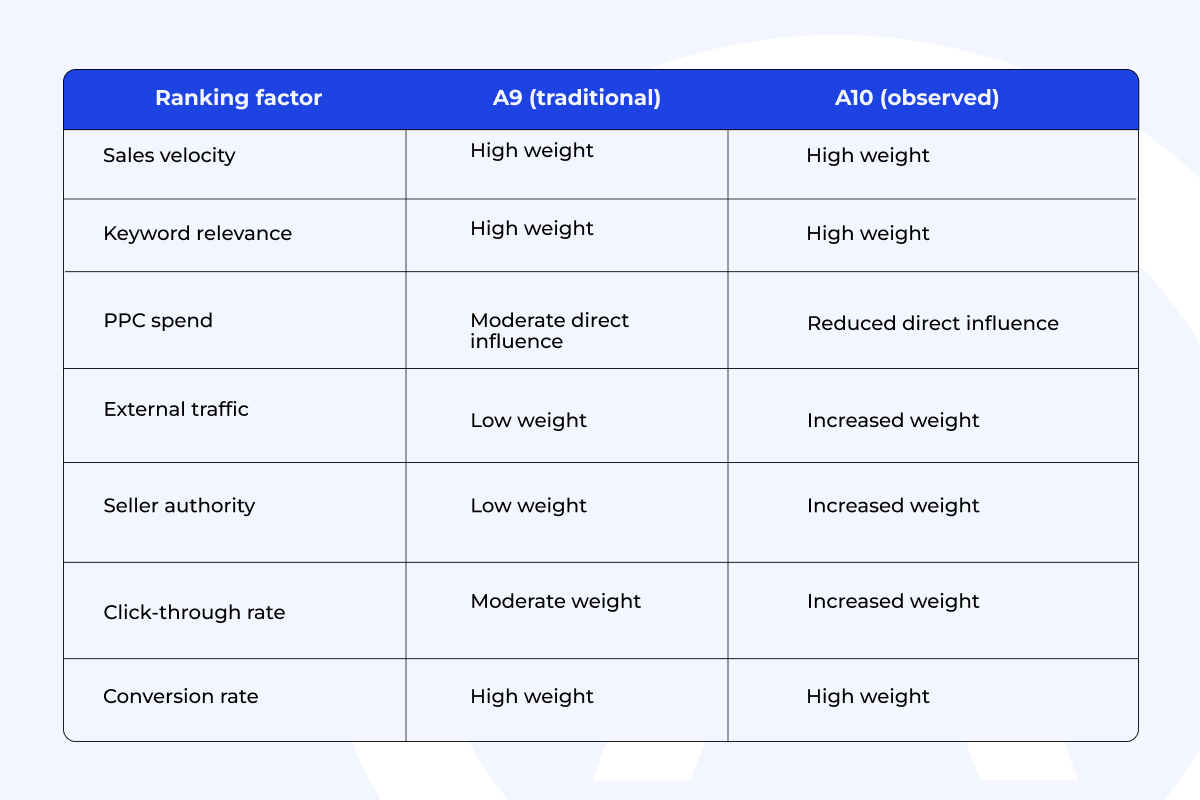
COSMO (Common Sense Knowledge Graph) is Amazon's LLM-based layer that understands context and natural language rather than exact keywords. Amazon Science reports that COSMO improved downstream task performance by as much as 60% in evaluations. In a controlled A/B test covering roughly 10% of U.S. traffic, COSMO produced a 0.7% relative increase in product sales and an 8% increase in navigation engagement, according to the COSMO research paper.

COSMO does not replace A9; it augments it. A9's keyword matching and conversion-based ranking remain active. COSMO adds semantic understanding for broad or ambiguous queries. A search for "furniture for a small apartment" through A9 returns listings containing those keywords. COSMO understands the shopper likely wants multi-functional, space-saving furniture, even if those products are not listed under that phrase.

Rufus, renamed to Alexa for Shopping on May 13, 2026, is Amazon's AI shopping assistant. It answers shopper questions, compares products, and now integrates Sponsored Ads within conversational recommendations. Built on Amazon Bedrock, it draws on LLMs including Anthropic's Claude Sonnet and Amazon Nova, plus the product catalog, customer reviews, and community Q&As.

The three metrics that matter most in 2026, per multiple independent analyses: click-through rate, conversion rate, and sales velocity. The ranking formula is not published, so all factor claims come from seller observation and agency testing. Treat them as informed consensus, not confirmed fact.

Intent-driven keyword research for Amazon listings

In 2026, intent matters more than raw search volume. Long-tail queries, typically four or more words, convert better because the shopper's intent is specific. A search for "shoes" tells you little. "Women's trail running shoes size 8 wide" tells you exactly what to show.

Native research methods give you the most reliable data. Start with autocomplete suggestions in Amazon's search box, which reflect what shoppers actually type. Scan competitor listings for keywords they target. If you have Brand Registry, use the Search Query Performance dashboard in Brand Analytics, which reports impressions, clicks, cart adds, and purchases per query for your brand and ASINs.

Third-party tools like Helium 10 and Jungle Scout provide search volume estimates and competitor keyword data. SellerSprite offers keyword analytics as well. Validate tool data against Brand Analytics wherever possible, since that data comes from actual shopper behavior.

Build a keyword map that assigns your primary keyword, supporting keywords, and long-tail variations to specific listing fields: title, bullets, description, and backend terms. Semantic matching means your listing can rank for terms you never explicitly included, so cover topics and use cases, not just exact-match strings.

Qualify each keyword against four criteria: relevance to the product, realistic competition level, evidence of purchase intent, and fit within the listing. This prevents you from chasing high-volume terms that never convert.

Optimizing every element of a product listing

Product title

Amazon caps product titles at 200 characters but recommends 60 or fewer. Include your brand, product type, and descriptive attributes. Amazon's January 2025 title policy restricts excessive special characters, repeated words, and requires natural language. Non-compliant titles can be auto-updated after a 14-day grace period.

Bullet points

Start each bullet with a one- or two-word descriptor. Keep explanations under roughly 100 characters. Use fragments, capitalize the first letter, and lead with benefits and use cases rather than feature lists. Shoppers scan bullets before reading anything else.

Product description and A+ Content

Use storytelling and rich content modules to address objections and communicate value. A+ Content is available to Brand Registry brands and measurably improves conversion. Comparison charts and brand story modules help shoppers decide without leaving your page.

Backend search terms

Amazon's 250-byte limit applies. Use all lowercase, spaces only (no commas), skip articles and prepositions, and never repeat words already in the listing. Treat backend fields as spillover for keywords that do not fit naturally elsewhere.

Attributes and category fields

Structured data feeds COSMO and Rufus. Complete every relevant field. Incomplete attributes are a common reason listings miss AI-driven queries. Amazon advises against keyword stuffing: if you use a key phrase once, you probably do not need to use it again. COSMO's semantic understanding makes repetition counterproductive.

Images and A+ Content: visual assets that drive conversion

Your main image is now an SEO asset. Listings with higher-CTR main images consistently gain organic rank over comparable products, because the image determines whether a shopper clicks, and clicks feed the ranking signal.

Amazon requires a plain white background for the main image, with the product filling 85% or more of the frame. The image must be clear and well-lit. Build an image stack that includes the main image, alternate angles, lifestyle or context images, infographic images communicating dimensions and materials, and images that answer common pre-purchase questions.

For A+ Content, use comparison charts, brand story modules, and visual objection-handling. Alt-text should be a simple sentence including one or two keywords. Show scale next to a familiar object, show the product in use, and answer the questions that appear most often in your reviews.

Algofy's creative design team builds conversion-focused listing and ad creative for brands that want this handled end to end.

Performance signals that decide rankings: reviews, price, inventory, and fulfillment

Reviews and ratings present an honest disagreement among agencies. Some report that reviews no longer directly influence rank as strongly as before. Others find authentic feedback still heavily weighted. Either way, reviews drive conversion, because review count and rating give shoppers the confidence to buy from search results.

Price competitiveness matters because competitive pricing drives conversion. Amazon's Automate Pricing tool and Revenue Calculator help you find margin-aware pricing by fulfillment method.

Inventory management is critical. Running out of stock resets sales velocity and damages rank. The 100-day return window policy in certain categories demands proactive inventory planning. Stockouts can undo months of ranking work.

Fulfillment method affects ranking. FBA generally outranks FBM, largely due to Prime eligibility. Seller authority also influences product-level rankings: account health metrics like order defect rate, late shipment rate, and policy compliance, along with account age, seller feedback, and Brand Registry enrollment, all contribute.

The 2026 consensus from controlled testing: excellent listings, real sales from organic plus paid traffic, and clean operational metrics (in-stock rate, shipping speed, customer satisfaction) are what Amazon's algorithm rewards.

Using Amazon PPC and external traffic to grow organic rank

Agencies disagree on how directly PPC sales influence organic rank today. Some testing shows reduced direct influence. Other large-account data still calls PPC the biggest ranking driver. What is not disputed: PPC drives the sales velocity and keyword testing that feed organic growth.

Sponsored Products work for keyword testing and velocity. Sponsored Brands defend and build awareness. Sponsored Display handles retargeting. Use exact-match campaigns on target keywords, measure conversion, then fold proven converters into your listing copy.

External traffic from Google Ads, social media, email, and influencer links now acts as a ranking signal. Amazon rewards sellers who bring new customers into its ecosystem. The Brand Referral Bonus program credits back a percentage of sales from qualifying external traffic, offsetting the cost of driving off-platform traffic.

Rufus now surfaces Sponsored Ads within conversational recommendations, tightening the link between paid and AI-driven discovery. Expert-led Amazon and search ads campaigns keep paid and organic working as one system.

Conversion rate optimization and A/B testing on Amazon

Amazon's algorithm rewards listings that convert, so CRO is an SEO activity. Helium 10 puts the average Amazon conversion rate at roughly 10%, and it varies widely by category. Use this as a benchmark, not a target; your category and price point determine what is realistic.

Find your number in Seller Central Business Reports. Unit Session Percentage (USP) is total orders divided by total sessions, times 100. If you are well below category norms, focus on images, bullet points, and review count first.

Manage Your Experiments, available to Brand Registry brands, lets you A/B test titles, images, descriptions, and A+ Content. Run one test at a time, wait for statistical significance, and avoid jumping to conclusions from early data.

CRO levers include objection-handling copy, clear sizing and compatibility information, addressing top questions from reviews and returns data, and removing friction in the buy box experience. Amazon's "Enhance My Listing" is part of a set of generative AI listing tools that more than 900,000 selling partners have used, but AI-generated text usually needs manual refinement to match brand voice and accuracy.

An Amazon SEO checklist for tracking, auditing, and improving

Run this checklist monthly or quarterly to catch issues before they cost you rank.

Metrics to track: sales velocity, conversion rate (USP), click-through rate, search query performance (impressions, clicks, cart adds per query), and share of voice on target keywords.

  1. Confirm each ASIN is indexed for its target keywords
  2. Check for suppressed or incomplete listings in Seller Central
  3. Verify attribute completeness across every relevant field
  4. Review backend search terms against the 250-byte rule
  5. Check image compliance (white background, 85% frame, multiple angles)
  6. Diagnose indexing issues: if a listing does not appear for its primary keyword, determine whether the cause is relevance, performance, or a data problem
  7. Review review velocity and rating trends
  8. Check stock levels and set reorder alerts to prevent stockouts
  9. Audit PPC campaigns for keyword performance and fold proven converters into listing copy
  10. Compare your share of voice against top competitors on target keywords

If your listing does not appear for its primary keyword, start with relevance and indexing before performance. Initial ranking changes typically appear within 2–4 weeks of optimization. Stable improvements usually take 2–3 months of consistent optimization and sustained sales performance. Factors like category competitiveness, sales volume, and current indexing status affect the timeline.

Common Amazon SEO mistakes to avoid

Keyword stuffing in titles and backend fields is the most common mistake. Amazon explicitly warns against repeating key phrases, and COSMO's semantic understanding makes stuffing counterproductive. Keywords remain necessary for indexing, but repetition now carries risk.

Ignoring backend search terms entirely, or wasting the 250 bytes on duplicates, commas, or words already in the listing, wastes a free optimization opportunity. Poor or non-compliant images suppress CTR and rank: cluttered main images, missing lifestyle shots, and images that fail the 85% frame rule all hurt.

Treating reviews as an afterthought is a missed opportunity. Not requesting reviews via official tools and not mining negative reviews for listing improvements leaves conversion on the table. Letting inventory run out resets sales velocity and can undo months of ranking work.

Failing to adapt to algorithm and policy changes is perhaps the most costly mistake. The 2025 title policy and AI-driven discovery have shifted what works. Tactics from a few years ago may no longer produce results. Shoppers routinely compare several listings before buying, so winning requires sustained execution, not one-off fixes.

What Rufus and Alexa for Shopping mean for the future of Amazon SEO

Alexa for Shopping, formerly Rufus, is Amazon's AI shopping assistant. It answers shopper questions, compares products, and integrates Sponsored Ads within conversational recommendations. When a shopper's first interaction is with an AI assistant, your listing needs to answer questions, not just match keywords.

In broader AI-search research (Google's AI Overviews, not Amazon-specific), Ahrefs found that AI Overviews appear on 9.5% of single-word queries but 46.4% of queries with seven or more words. While those figures come from Google's AI Overviews rather than Amazon's own data, the pattern aligns with what sellers report on Amazon: conversational queries produce more targeted traffic. Use the Prompts report in Amazon Ads to see which sponsored prompts, and the ads behind them, earn impressions, clicks, and orders, including prompts that open in Alexa for Shopping conversations.

The practical implication: write listings that answer real shopper questions. Complete every attribute field. Keep content accurate. AI assistants draw on structured data and listing copy to compose answers. Brands that maintain clean data, strong conversion metrics, and clear benefit-led copy are the ones AI surfaces.

The fundamentals have not changed, but the bar for execution has risen. Brands that treat Amazon SEO as an ongoing, data-driven discipline will be the ones AI recommends. For a deeper look at how conversational AI is reshaping product discovery, see our analysis of Rufus and product discovery in 2026.

Frequently asked questions about Amazon SEO

Here are answers to the most common questions about Amazon SEO.

How does Amazon SEO work?

Amazon SEO is the practice of optimizing product listings so they rank higher in Amazon's search results. Amazon's algorithm ranks products based on relevance to the search query, conversion rate, and sales velocity. If a listing is not ranking for its primary keyword, the first diagnostic step is to confirm the ASIN is indexed for that term in Seller Central before assuming a performance problem.

What is the difference between Amazon SEO and Google SEO?

Google ranks content on relevance, quality, and authority signals such as backlinks. It uses aggregated interaction data as one input but has said it does not use bounce rate directly, and conversion rate is not a Google ranking factor. Amazon's algorithm does not use backlinks as a product-ranking signal and ranks products by how likely they are to sell, weighing conversion rate, sales velocity, and shopper experience signals like CTR. Google optimizes for relevance and authority; Amazon optimizes for conversions and sales.

How long does Amazon SEO take to work?

Initial ranking changes typically appear within 2–4 weeks of optimization, with stable improvements taking 2–3 months of consistent optimization and sales performance. Category competitiveness, sales volume, and current indexing status all affect the timeline. Results compound as conversion data accumulates rather than arriving as a one-time boost.

Does Amazon PPC help organic rankings?

Yes, but indirectly. Whether PPC sales directly move organic rank is debated among agencies, but PPC reliably drives the sales velocity and keyword-level conversion data that feed organic growth. PPC functions as a testing and momentum tool rather than a ranking shortcut.

What is a good conversion rate on Amazon?

Helium 10 puts the average Amazon conversion rate at roughly 10%, though it varies widely by category and price point. Find your number by dividing total orders by total sessions and multiplying by 100. Amazon reports this as Unit Session Percentage in Seller Central Business Reports. If you are well below category norms, focus on images, bullet points, and review count first.

Get an expert-led Amazon growth plan from Algofy

Executing a full Amazon SEO strategy, from keyword research to listing optimization, PPC, CRO, and ongoing audits, is a lot for an in-house team to sustain. Algofy handles expert-led Amazon campaigns, optimizations, and automations, plus data-driven SEO, all managed as one growth system.

Book a call with Algofy and receive a tailored roadmap for your Amazon presence. Start turning listing traffic into revenue.

 Check out our job openings here
Contact Us

Amazon SEO Strategy: The Complete Guide For 2026

October 9, 2026

The practical shift in Amazon SEO over the past two years is not about keywords disappearing. It is about how retrieval, conversion, operational execution, and AI-readable listing data now interact. A listing that ranks in 2026 wins on four fronts at once: it matches what shoppers type, it converts the traffic it receives, it keeps operational metrics clean, and it carries structured data that AI assistants like Alexa for Shopping can read. This guide covers how Amazon's algorithm has evolved, how to research keywords by intent, how to optimize every listing element, and how to build a repeatable audit process. Whether you manage one ASIN or a full catalog, you will leave with a checklist you can run this week.

Table of Contents

  1. What Amazon SEO means in 2026 (and how it differs from Google SEO)
  2. How Amazon's ranking algorithm works now: A9, A10, COSMO, and AI
  3. Intent-driven keyword research for Amazon listings
  4. Optimizing every element of a product listing
    • Product title
    • Bullet points
    • Product description and A+ Content
    • Backend search terms
    • Attributes and category fields
  5. Images and A+ Content: visual assets that drive conversion
  6. Performance signals that decide rankings: reviews, price, inventory, and fulfillment
  7. Using Amazon PPC and external traffic to grow organic rank
  8. Conversion rate optimization and A/B testing on Amazon
  9. An Amazon SEO checklist for tracking, auditing, and improving
  10. Common Amazon SEO mistakes to avoid
  11. What Rufus and Alexa for Shopping mean for the future of Amazon SEO
  12. Frequently asked questions about Amazon SEO
    • How does Amazon SEO work?
    • What is the difference between Amazon SEO and Google SEO?
    • How long does Amazon SEO take to work?
    • Does Amazon PPC help organic rankings?
    • What is a good conversion rate on Amazon?
  13. Get an expert-led Amazon growth plan from Algofy

What Amazon SEO means in 2026 (and how it differs from Google SEO)

Amazon SEO is the practice of optimizing product listings so they rank higher in Amazon's search results and recommendation surfaces. The goal is sales, not clicks or traffic.

The scale of the opportunity is large. Amazon does not publish its total search volume, and third-party estimates vary widely, but it is where a large share of U.S. shoppers start their product searches.

The core difference from Google SEO is simple. Amazon's algorithm ranks products by how likely they are to sell. It does not consider backlinks, time-on-page, or bounce rate. Google focuses on relevance and authority; Amazon optimizes for conversion and sales velocity. On where shoppers start product searches, survey figures range from more than half of consumers (Jungle Scout) to 90% of Amazon customers (CIRP), depending on methodology.

In 2026, Amazon SEO spans more than keyword placement. It covers structured listing data, conversion performance, external traffic, seller authority, and AI-driven discovery through tools like Alexa for Shopping. An effective strategy treats all of these as connected parts of one growth system. Many listings never reach page one for their primary keyword, and that gap is the structural advantage for sellers who adapt to the current algorithm.

How Amazon's ranking algorithm works now: A9, A10, COSMO, and AI

Amazon's product search algorithm, known as A9, has been the foundation of its search since the A9.com subsidiary. Amazon's own seller guidance says listing quality, competitive pricing, and account health can contribute to search rankings, and sellers consistently observe that better-selling products tend toward the beginning of results.

Since late 2024, sellers have observed ranking changes consistent with what the community calls "A10." Amazon has never officially announced an A10 algorithm and does not publish its ranking formula. What sellers report: more weight on organic sales, external traffic, seller authority, and click-through rate, with less direct influence from aggressive PPC spend.

COSMO (Common Sense Knowledge Graph) is Amazon's LLM-based layer that understands context and natural language rather than exact keywords. Amazon Science reports that COSMO improved downstream task performance by as much as 60% in evaluations. In a controlled A/B test covering roughly 10% of U.S. traffic, COSMO produced a 0.7% relative increase in product sales and an 8% increase in navigation engagement, according to the COSMO research paper.

COSMO does not replace A9; it augments it. A9's keyword matching and conversion-based ranking remain active. COSMO adds semantic understanding for broad or ambiguous queries. A search for "furniture for a small apartment" through A9 returns listings containing those keywords. COSMO understands the shopper likely wants multi-functional, space-saving furniture, even if those products are not listed under that phrase.

Rufus, renamed to Alexa for Shopping on May 13, 2026, is Amazon's AI shopping assistant. It answers shopper questions, compares products, and now integrates Sponsored Ads within conversational recommendations. Built on Amazon Bedrock, it draws on LLMs including Anthropic's Claude Sonnet and Amazon Nova, plus the product catalog, customer reviews, and community Q&As.

The three metrics that matter most in 2026, per multiple independent analyses: click-through rate, conversion rate, and sales velocity. The ranking formula is not published, so all factor claims come from seller observation and agency testing. Treat them as informed consensus, not confirmed fact.

Intent-driven keyword research for Amazon listings

In 2026, intent matters more than raw search volume. Long-tail queries, typically four or more words, convert better because the shopper's intent is specific. A search for "shoes" tells you little. "Women's trail running shoes size 8 wide" tells you exactly what to show.

Native research methods give you the most reliable data. Start with autocomplete suggestions in Amazon's search box, which reflect what shoppers actually type. Scan competitor listings for keywords they target. If you have Brand Registry, use the Search Query Performance dashboard in Brand Analytics, which reports impressions, clicks, cart adds, and purchases per query for your brand and ASINs.

Third-party tools like Helium 10 and Jungle Scout provide search volume estimates and competitor keyword data. SellerSprite offers keyword analytics as well. Validate tool data against Brand Analytics wherever possible, since that data comes from actual shopper behavior.

Build a keyword map that assigns your primary keyword, supporting keywords, and long-tail variations to specific listing fields: title, bullets, description, and backend terms. Semantic matching means your listing can rank for terms you never explicitly included, so cover topics and use cases, not just exact-match strings.

Qualify each keyword against four criteria: relevance to the product, realistic competition level, evidence of purchase intent, and fit within the listing. This prevents you from chasing high-volume terms that never convert.

Optimizing every element of a product listing

Product title

Amazon caps product titles at 200 characters but recommends 60 or fewer. Include your brand, product type, and descriptive attributes. Amazon's January 2025 title policy restricts excessive special characters, repeated words, and requires natural language. Non-compliant titles can be auto-updated after a 14-day grace period.

Bullet points

Start each bullet with a one- or two-word descriptor. Keep explanations under roughly 100 characters. Use fragments, capitalize the first letter, and lead with benefits and use cases rather than feature lists. Shoppers scan bullets before reading anything else.

Product description and A+ Content

Use storytelling and rich content modules to address objections and communicate value. A+ Content is available to Brand Registry brands and measurably improves conversion. Comparison charts and brand story modules help shoppers decide without leaving your page.

Backend search terms

Amazon's 250-byte limit applies. Use all lowercase, spaces only (no commas), skip articles and prepositions, and never repeat words already in the listing. Treat backend fields as spillover for keywords that do not fit naturally elsewhere.

Attributes and category fields

Structured data feeds COSMO and Rufus. Complete every relevant field. Incomplete attributes are a common reason listings miss AI-driven queries. Amazon advises against keyword stuffing: if you use a key phrase once, you probably do not need to use it again. COSMO's semantic understanding makes repetition counterproductive.

Images and A+ Content: visual assets that drive conversion

Your main image is now an SEO asset. Listings with higher-CTR main images consistently gain organic rank over comparable products, because the image determines whether a shopper clicks, and clicks feed the ranking signal.

Amazon requires a plain white background for the main image, with the product filling 85% or more of the frame. The image must be clear and well-lit. Build an image stack that includes the main image, alternate angles, lifestyle or context images, infographic images communicating dimensions and materials, and images that answer common pre-purchase questions.

For A+ Content, use comparison charts, brand story modules, and visual objection-handling. Alt-text should be a simple sentence including one or two keywords. Show scale next to a familiar object, show the product in use, and answer the questions that appear most often in your reviews.

Algofy's creative design team builds conversion-focused listing and ad creative for brands that want this handled end to end.

Performance signals that decide rankings: reviews, price, inventory, and fulfillment

Reviews and ratings present an honest disagreement among agencies. Some report that reviews no longer directly influence rank as strongly as before. Others find authentic feedback still heavily weighted. Either way, reviews drive conversion, because review count and rating give shoppers the confidence to buy from search results.

Price competitiveness matters because competitive pricing drives conversion. Amazon's Automate Pricing tool and Revenue Calculator help you find margin-aware pricing by fulfillment method.

Inventory management is critical. Running out of stock resets sales velocity and damages rank. The 100-day return window policy in certain categories demands proactive inventory planning. Stockouts can undo months of ranking work.

Fulfillment method affects ranking. FBA generally outranks FBM, largely due to Prime eligibility. Seller authority also influences product-level rankings: account health metrics like order defect rate, late shipment rate, and policy compliance, along with account age, seller feedback, and Brand Registry enrollment, all contribute.

The 2026 consensus from controlled testing: excellent listings, real sales from organic plus paid traffic, and clean operational metrics (in-stock rate, shipping speed, customer satisfaction) are what Amazon's algorithm rewards.

Using Amazon PPC and external traffic to grow organic rank

Agencies disagree on how directly PPC sales influence organic rank today. Some testing shows reduced direct influence. Other large-account data still calls PPC the biggest ranking driver. What is not disputed: PPC drives the sales velocity and keyword testing that feed organic growth.

Sponsored Products work for keyword testing and velocity. Sponsored Brands defend and build awareness. Sponsored Display handles retargeting. Use exact-match campaigns on target keywords, measure conversion, then fold proven converters into your listing copy.

External traffic from Google Ads, social media, email, and influencer links now acts as a ranking signal. Amazon rewards sellers who bring new customers into its ecosystem. The Brand Referral Bonus program credits back a percentage of sales from qualifying external traffic, offsetting the cost of driving off-platform traffic.

Rufus now surfaces Sponsored Ads within conversational recommendations, tightening the link between paid and AI-driven discovery. Expert-led Amazon and search ads campaigns keep paid and organic working as one system.

Conversion rate optimization and A/B testing on Amazon

Amazon's algorithm rewards listings that convert, so CRO is an SEO activity. Helium 10 puts the average Amazon conversion rate at roughly 10%, and it varies widely by category. Use this as a benchmark, not a target; your category and price point determine what is realistic.

Find your number in Seller Central Business Reports. Unit Session Percentage (USP) is total orders divided by total sessions, times 100. If you are well below category norms, focus on images, bullet points, and review count first.

Manage Your Experiments, available to Brand Registry brands, lets you A/B test titles, images, descriptions, and A+ Content. Run one test at a time, wait for statistical significance, and avoid jumping to conclusions from early data.

CRO levers include objection-handling copy, clear sizing and compatibility information, addressing top questions from reviews and returns data, and removing friction in the buy box experience. Amazon's "Enhance My Listing" is part of a set of generative AI listing tools that more than 900,000 selling partners have used, but AI-generated text usually needs manual refinement to match brand voice and accuracy.

An Amazon SEO checklist for tracking, auditing, and improving

Run this checklist monthly or quarterly to catch issues before they cost you rank.

Metrics to track: sales velocity, conversion rate (USP), click-through rate, search query performance (impressions, clicks, cart adds per query), and share of voice on target keywords.

  1. Confirm each ASIN is indexed for its target keywords
  2. Check for suppressed or incomplete listings in Seller Central
  3. Verify attribute completeness across every relevant field
  4. Review backend search terms against the 250-byte rule
  5. Check image compliance (white background, 85% frame, multiple angles)
  6. Diagnose indexing issues: if a listing does not appear for its primary keyword, determine whether the cause is relevance, performance, or a data problem
  7. Review review velocity and rating trends
  8. Check stock levels and set reorder alerts to prevent stockouts
  9. Audit PPC campaigns for keyword performance and fold proven converters into listing copy
  10. Compare your share of voice against top competitors on target keywords

If your listing does not appear for its primary keyword, start with relevance and indexing before performance. Initial ranking changes typically appear within 2–4 weeks of optimization. Stable improvements usually take 2–3 months of consistent optimization and sustained sales performance. Factors like category competitiveness, sales volume, and current indexing status affect the timeline.

Common Amazon SEO mistakes to avoid

Keyword stuffing in titles and backend fields is the most common mistake. Amazon explicitly warns against repeating key phrases, and COSMO's semantic understanding makes stuffing counterproductive. Keywords remain necessary for indexing, but repetition now carries risk.

Ignoring backend search terms entirely, or wasting the 250 bytes on duplicates, commas, or words already in the listing, wastes a free optimization opportunity. Poor or non-compliant images suppress CTR and rank: cluttered main images, missing lifestyle shots, and images that fail the 85% frame rule all hurt.

Treating reviews as an afterthought is a missed opportunity. Not requesting reviews via official tools and not mining negative reviews for listing improvements leaves conversion on the table. Letting inventory run out resets sales velocity and can undo months of ranking work.

Failing to adapt to algorithm and policy changes is perhaps the most costly mistake. The 2025 title policy and AI-driven discovery have shifted what works. Tactics from a few years ago may no longer produce results. Shoppers routinely compare several listings before buying, so winning requires sustained execution, not one-off fixes.

What Rufus and Alexa for Shopping mean for the future of Amazon SEO

Alexa for Shopping, formerly Rufus, is Amazon's AI shopping assistant. It answers shopper questions, compares products, and integrates Sponsored Ads within conversational recommendations. When a shopper's first interaction is with an AI assistant, your listing needs to answer questions, not just match keywords.

In broader AI-search research (Google's AI Overviews, not Amazon-specific), Ahrefs found that AI Overviews appear on 9.5% of single-word queries but 46.4% of queries with seven or more words. While those figures come from Google's AI Overviews rather than Amazon's own data, the pattern aligns with what sellers report on Amazon: conversational queries produce more targeted traffic. Use the Prompts report in Amazon Ads to see which sponsored prompts, and the ads behind them, earn impressions, clicks, and orders, including prompts that open in Alexa for Shopping conversations.

The practical implication: write listings that answer real shopper questions. Complete every attribute field. Keep content accurate. AI assistants draw on structured data and listing copy to compose answers. Brands that maintain clean data, strong conversion metrics, and clear benefit-led copy are the ones AI surfaces.

The fundamentals have not changed, but the bar for execution has risen. Brands that treat Amazon SEO as an ongoing, data-driven discipline will be the ones AI recommends. For a deeper look at how conversational AI is reshaping product discovery, see our analysis of Rufus and product discovery in 2026.

Frequently asked questions about Amazon SEO

Here are answers to the most common questions about Amazon SEO.

How does Amazon SEO work?

Amazon SEO is the practice of optimizing product listings so they rank higher in Amazon's search results. Amazon's algorithm ranks products based on relevance to the search query, conversion rate, and sales velocity. If a listing is not ranking for its primary keyword, the first diagnostic step is to confirm the ASIN is indexed for that term in Seller Central before assuming a performance problem.

What is the difference between Amazon SEO and Google SEO?

Google ranks content on relevance, quality, and authority signals such as backlinks. It uses aggregated interaction data as one input but has said it does not use bounce rate directly, and conversion rate is not a Google ranking factor. Amazon's algorithm does not use backlinks as a product-ranking signal and ranks products by how likely they are to sell, weighing conversion rate, sales velocity, and shopper experience signals like CTR. Google optimizes for relevance and authority; Amazon optimizes for conversions and sales.

How long does Amazon SEO take to work?

Initial ranking changes typically appear within 2–4 weeks of optimization, with stable improvements taking 2–3 months of consistent optimization and sales performance. Category competitiveness, sales volume, and current indexing status all affect the timeline. Results compound as conversion data accumulates rather than arriving as a one-time boost.

Does Amazon PPC help organic rankings?

Yes, but indirectly. Whether PPC sales directly move organic rank is debated among agencies, but PPC reliably drives the sales velocity and keyword-level conversion data that feed organic growth. PPC functions as a testing and momentum tool rather than a ranking shortcut.

What is a good conversion rate on Amazon?

Helium 10 puts the average Amazon conversion rate at roughly 10%, though it varies widely by category and price point. Find your number by dividing total orders by total sessions and multiplying by 100. Amazon reports this as Unit Session Percentage in Seller Central Business Reports. If you are well below category norms, focus on images, bullet points, and review count first.

Get an expert-led Amazon growth plan from Algofy

Executing a full Amazon SEO strategy, from keyword research to listing optimization, PPC, CRO, and ongoing audits, is a lot for an in-house team to sustain. Algofy handles expert-led Amazon campaigns, optimizations, and automations, plus data-driven SEO, all managed as one growth system.

Book a call with Algofy and receive a tailored roadmap for your Amazon presence. Start turning listing traffic into revenue.

Related articles

article

Top 10 Amazon Ads Agencies in the US For 2026

article

Amazon SEO Strategy: The Complete Guide For 2026

article

The 90-Day BFCM Prep Guide for Amazon Sellers: Your September–November Roadmap