
September 14, 2026

The 90-Day BFCM Prep Guide for Amazon Sellers: Your September–November Roadmap

Strategy

Black Friday and Cyber Monday can bring some of the biggest shopping days of the year, but strong Amazon performance rarely begins during BFCM week itself. By then, much of the important work should already be done.

For Amazon sellers, ecommerce brands, and DTC businesses expanding their marketplace presence, BFCM preparation should start months earlier. Listings need time to improve. Inventory needs to reach the right place. Advertising campaigns need data. Offers need planning. And small problems are much easier to solve in September than when holiday traffic is already arriving.

Here’s a practical 90-day Amazon BFCM prep guide to help you move from planning to execution.

Key Takeaways

  • September: Audit listings, strengthen Amazon SEO and product content, forecast demand, review pricing, and plan inventory.
  • October: Finalize offers, prepare advertising campaigns, optimize your storefront, and position inventory for higher demand.
  • Early November: Confirm promotions, test listings, increase advertising strategically, and monitor inventory closely.
  • BFCM Week: Track sales, advertising, inventory, and competitive activity daily, then adjust budgets, bids, and promotions as needed.
  • Post-BFCM: Use your performance data to improve December campaigns, retarget shoppers, and manage remaining holiday inventory.

September: Build the Foundation

September is the month to fix what could become expensive during peak season.

Start with a complete audit of your Amazon presence. Review product titles, bullets, descriptions, images, A+ Content, backend search terms, and storefront pages. Look at them from the shopper’s perspective. Is the value proposition obvious? Are common questions answered? Does the content help someone compare options quickly?

Search optimization matters here too. Identify the search terms driving relevant traffic and make sure your listings reflect how customers are currently looking for your products. The goal is not keyword stuffing. It is stronger relevance paired with persuasive product content.

Your storefront deserves similar attention. A well-organized SEO-optimized Amazon storefront can make it easier for shoppers discovering one product to explore the rest of your range.

Then turn to inventory.

Review historical sales, seasonal demand, current stock, lead times, and your expected promotional lift. Decide which SKUs need deeper inventory coverage and which products should remain more conservative.

This is also the time to review pricing and margins. A large discount can generate volume while quietly eroding profitability. Know the lowest promotional price each product can realistically support before October negotiations and campaign planning begin.

October: Prepare for BFCM Traffic

By October, the strategy should start becoming tangible.

Finalize the products you intend to promote and determine the offer for each. Your best BFCM promotion does not necessarily have to be your deepest discount across the entire catalog. Prioritize products where increased visibility and volume support the broader business.

Next, prepare your advertising.

Build or refine Amazon PPC campaigns early enough to gather useful performance information before BFCM. Review search terms, campaign structure, bids, budgets, and product-level performance. Identify campaigns that can scale and areas where spend is producing little return.

Creative also needs a final review. Product images, comparison graphics, A+ Content, and storefront pages should work together rather than feel like separate pieces of the customer journey.

Inventory should already be moving into position as well. Holiday demand is unforgiving when stock is late. If forecasting and fulfillment are still causing uncertainty, Algofy’s guide to building a stronger Amazon fulfillment strategy is a useful place to go deeper.

October is essentially your rehearsal. The fewer unresolved questions you carry into November, the more attention you can give to performance.

Early November: Get Campaign-Ready

Early November is about validation rather than major reinvention.

Confirm that planned promotions are set correctly. Check your listings again for errors, suppressed content, outdated messaging, inconsistent pricing, or missing creative.

Then examine advertising performance and start increasing spend strategically where the data supports it.

That last part matters. BFCM enthusiasm can make it tempting to raise every budget at once. Instead, concentrate resources on campaigns, keywords, and products with the clearest opportunity to convert additional traffic profitably.

Watch inventory by SKU and sales velocity closely. If one product begins moving faster than forecast, you want to know before BFCM week, not after it sells out.

You should also test the customer journey. Search for the product. Open the listing. Navigate through the storefront. Check the offer. Review the experience on mobile.

Small friction points become much bigger when traffic multiplies.

BFCM Week: Execute, Monitor, and Optimize
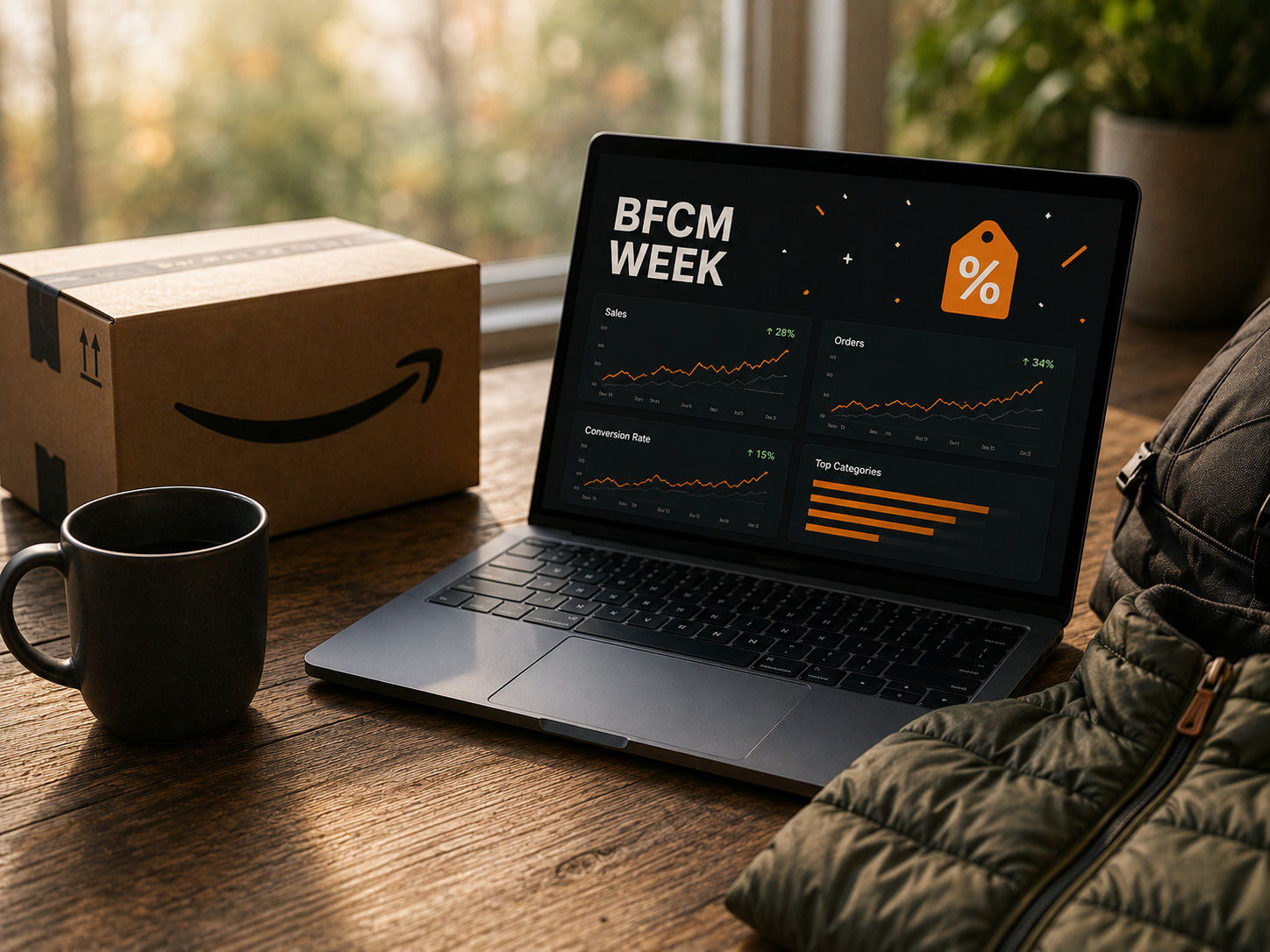
Once BFCM arrives, planning gives way to active management.

Monitor sales, advertising spend, conversion, inventory, and promotional performance throughout the event. Compare actual results against your forecasts and adjust quickly when the numbers move in an unexpected direction.

A campaign spending aggressively without corresponding sales may need tighter bids or budget allocation. A high-performing SKU may deserve additional support. A product running low on inventory may require reduced advertising before you create a stockout.

This is why preparation matters so much. When your foundations are already strong, BFCM week becomes an optimization exercise rather than an emergency.

Post-BFCM: Turn the Data Into December Growth

BFCM ending does not mean your holiday strategy is finished.

Review which products, keywords, offers, campaigns, and creative generated the strongest results. Look beyond total revenue. Consider conversion, ad efficiency, profitability, inventory position, and customer acquisition.

Then use those insights for December.

Retarget shoppers who engaged but did not purchase. Reallocate spend toward proven products. Adjust promotions around remaining inventory. Apply successful BFCM search terms and messaging to your holiday campaigns.

The goal is to carry useful momentum forward rather than reset everything once Cyber Monday ends.

FAQs About BFCM Preparation for Amazon Sellers

When should Amazon sellers start preparing for BFCM?

A structured BFCM strategy should begin well before November. Starting in September gives brands time to optimize listings, forecast inventory, review pricing, and prepare campaigns before holiday traffic increases.

What should Amazon sellers prioritize before Black Friday?

Focus first on product availability, listing quality, promotional economics, and advertising readiness. Driving more traffic will not help much if the listing does not convert or inventory cannot support increased demand.

Should Amazon sellers increase PPC budgets during BFCM?

Higher traffic can justify larger budgets, but increases should be based on campaign performance and inventory availability. Prioritize campaigns and products that demonstrate the strongest opportunity rather than increasing spend everywhere.

What should brands do after Cyber Monday?

Analyze BFCM performance and use the findings to guide December advertising, retargeting, inventory management, promotions, and broader holiday strategy.

Build Your BFCM Strategy Before the Rush

BFCM success on Amazon is rarely determined by one promotion or one week of aggressive advertising. It comes from three months of connected decisions across content, inventory, pricing, advertising, and optimization.

September gives you time to strengthen the foundation. October prepares the business for traffic. November puts the plan into action.

If your brand needs support connecting those pieces, book a call with our team at Algofy. From Amazon PPC and creative to listings, storefronts, inventory, and strategy, we can help you build a BFCM plan designed around profitable, scalable growth.

 Check out our job openings here
Contact Us

The 90-Day BFCM Prep Guide for Amazon Sellers: Your September–November Roadmap

September 14, 2026

Black Friday and Cyber Monday can bring some of the biggest shopping days of the year, but strong Amazon performance rarely begins during BFCM week itself. By then, much of the important work should already be done.

For Amazon sellers, ecommerce brands, and DTC businesses expanding their marketplace presence, BFCM preparation should start months earlier. Listings need time to improve. Inventory needs to reach the right place. Advertising campaigns need data. Offers need planning. And small problems are much easier to solve in September than when holiday traffic is already arriving.

Here’s a practical 90-day Amazon BFCM prep guide to help you move from planning to execution.

Key Takeaways

  • September: Audit listings, strengthen Amazon SEO and product content, forecast demand, review pricing, and plan inventory.
  • October: Finalize offers, prepare advertising campaigns, optimize your storefront, and position inventory for higher demand.
  • Early November: Confirm promotions, test listings, increase advertising strategically, and monitor inventory closely.
  • BFCM Week: Track sales, advertising, inventory, and competitive activity daily, then adjust budgets, bids, and promotions as needed.
  • Post-BFCM: Use your performance data to improve December campaigns, retarget shoppers, and manage remaining holiday inventory.

September: Build the Foundation

September is the month to fix what could become expensive during peak season.

Start with a complete audit of your Amazon presence. Review product titles, bullets, descriptions, images, A+ Content, backend search terms, and storefront pages. Look at them from the shopper’s perspective. Is the value proposition obvious? Are common questions answered? Does the content help someone compare options quickly?

Search optimization matters here too. Identify the search terms driving relevant traffic and make sure your listings reflect how customers are currently looking for your products. The goal is not keyword stuffing. It is stronger relevance paired with persuasive product content.

Your storefront deserves similar attention. A well-organized SEO-optimized Amazon storefront can make it easier for shoppers discovering one product to explore the rest of your range.

Then turn to inventory.

Review historical sales, seasonal demand, current stock, lead times, and your expected promotional lift. Decide which SKUs need deeper inventory coverage and which products should remain more conservative.

This is also the time to review pricing and margins. A large discount can generate volume while quietly eroding profitability. Know the lowest promotional price each product can realistically support before October negotiations and campaign planning begin.

October: Prepare for BFCM Traffic

By October, the strategy should start becoming tangible.

Finalize the products you intend to promote and determine the offer for each. Your best BFCM promotion does not necessarily have to be your deepest discount across the entire catalog. Prioritize products where increased visibility and volume support the broader business.

Next, prepare your advertising.

Build or refine Amazon PPC campaigns early enough to gather useful performance information before BFCM. Review search terms, campaign structure, bids, budgets, and product-level performance. Identify campaigns that can scale and areas where spend is producing little return.

Creative also needs a final review. Product images, comparison graphics, A+ Content, and storefront pages should work together rather than feel like separate pieces of the customer journey.

Inventory should already be moving into position as well. Holiday demand is unforgiving when stock is late. If forecasting and fulfillment are still causing uncertainty, Algofy’s guide to building a stronger Amazon fulfillment strategy is a useful place to go deeper.

October is essentially your rehearsal. The fewer unresolved questions you carry into November, the more attention you can give to performance.

Early November: Get Campaign-Ready

Early November is about validation rather than major reinvention.

Confirm that planned promotions are set correctly. Check your listings again for errors, suppressed content, outdated messaging, inconsistent pricing, or missing creative.

Then examine advertising performance and start increasing spend strategically where the data supports it.

That last part matters. BFCM enthusiasm can make it tempting to raise every budget at once. Instead, concentrate resources on campaigns, keywords, and products with the clearest opportunity to convert additional traffic profitably.

Watch inventory by SKU and sales velocity closely. If one product begins moving faster than forecast, you want to know before BFCM week, not after it sells out.

You should also test the customer journey. Search for the product. Open the listing. Navigate through the storefront. Check the offer. Review the experience on mobile.

Small friction points become much bigger when traffic multiplies.

BFCM Week: Execute, Monitor, and Optimize

Once BFCM arrives, planning gives way to active management.

Monitor sales, advertising spend, conversion, inventory, and promotional performance throughout the event. Compare actual results against your forecasts and adjust quickly when the numbers move in an unexpected direction.

A campaign spending aggressively without corresponding sales may need tighter bids or budget allocation. A high-performing SKU may deserve additional support. A product running low on inventory may require reduced advertising before you create a stockout.

This is why preparation matters so much. When your foundations are already strong, BFCM week becomes an optimization exercise rather than an emergency.

Post-BFCM: Turn the Data Into December Growth

BFCM ending does not mean your holiday strategy is finished.

Review which products, keywords, offers, campaigns, and creative generated the strongest results. Look beyond total revenue. Consider conversion, ad efficiency, profitability, inventory position, and customer acquisition.

Then use those insights for December.

Retarget shoppers who engaged but did not purchase. Reallocate spend toward proven products. Adjust promotions around remaining inventory. Apply successful BFCM search terms and messaging to your holiday campaigns.

The goal is to carry useful momentum forward rather than reset everything once Cyber Monday ends.

FAQs About BFCM Preparation for Amazon Sellers

When should Amazon sellers start preparing for BFCM?

A structured BFCM strategy should begin well before November. Starting in September gives brands time to optimize listings, forecast inventory, review pricing, and prepare campaigns before holiday traffic increases.

What should Amazon sellers prioritize before Black Friday?

Focus first on product availability, listing quality, promotional economics, and advertising readiness. Driving more traffic will not help much if the listing does not convert or inventory cannot support increased demand.

Should Amazon sellers increase PPC budgets during BFCM?

Higher traffic can justify larger budgets, but increases should be based on campaign performance and inventory availability. Prioritize campaigns and products that demonstrate the strongest opportunity rather than increasing spend everywhere.

What should brands do after Cyber Monday?

Analyze BFCM performance and use the findings to guide December advertising, retargeting, inventory management, promotions, and broader holiday strategy.

Build Your BFCM Strategy Before the Rush

BFCM success on Amazon is rarely determined by one promotion or one week of aggressive advertising. It comes from three months of connected decisions across content, inventory, pricing, advertising, and optimization.

September gives you time to strengthen the foundation. October prepares the business for traffic. November puts the plan into action.

If your brand needs support connecting those pieces, book a call with our team at Algofy. From Amazon PPC and creative to listings, storefronts, inventory, and strategy, we can help you build a BFCM plan designed around profitable, scalable growth.

Related articles

article

The 90-Day BFCM Prep Guide for Amazon Sellers: Your September–November Roadmap

article

GEO for Ecommerce: How to Get Cited by ChatGPT, Perplexity and Claude

article

Amazon Account Suspended? Here’s Exactly What to Do in the First 48 Hours