










DTC brands can compete with Amazon by giving shoppers a compelling reason to buy directly: relevant product guidance, distinctive offers, dependable service, and a rewarding repeat-purchase experience. Brands that also sell on Amazon should give each channel a clear role, coordinate pricing and inventory, and evaluate growth against contribution after marketing costs.
You do not need your website to replicate Amazon’s catalog or delivery network. You need it to serve your customers well enough that buying directly feels worthwhile.
That might mean helping someone choose the right skincare routine, assembling an outdoor kit, or managing a replenishment schedule. Amazon can remain an important place to capture demand while your website builds a more flexible shopping experience.
The challenge is making those channels work together profitably.
Key Takeaways
- Decide whether Amazon fits your margins, products, and operating capacity before committing to both channels.
- Give each channel a clear role. Both channels can acquire and retain customers.
- Differentiate through useful offers and service. Amazon also supports subscriptions, bundles, and repeat purchases.
- Compare contribution after acquisition and fulfillment costs for each channel.
- Treat Buy with Prime and Multichannel Fulfillment as different services with different jobs.
- Measure channel performance separately and business performance together, accounting for attribution overlap and customer-identification limits.
Should DTC Brands Sell on Amazon and Their Own Websites?
Selling through both channels can make sense when there is relevant demand on Amazon, the product economics work, and your team can support the additional operation. It is not automatically the right choice for every DTC brand.
Start with three questions:
Is the demand relevant? Look at the products shoppers compare, the queries they use, and the offers already available. Category demand is useful only if your product can compete for the right customers.
Can the product support the costs? Model Amazon fees, fulfillment, storage, returns, and advertising alongside your website’s payment, fulfillment, acquisition, and retention costs.
Can you operate the channel well? Someone must own catalog accuracy, inventory, pricing, customer issues, and advertising. A neglected Amazon presence can create problems even when your website is performing well.
A customized product, a low-margin item with high fulfillment costs, or a brand with limited stock may be better served by improving the direct business first. In other cases, a limited Amazon launch with selected products is more informative than moving the entire catalog at once.
Compare the Economics of an Order
Consider this simplified hypothetical example for the same $50 product:
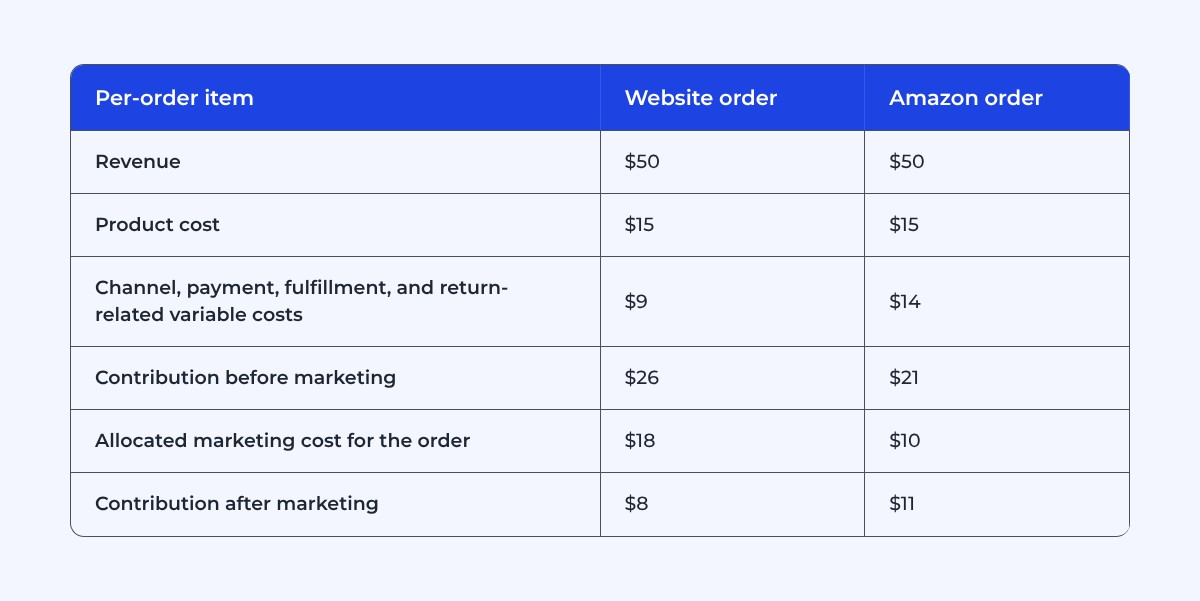
These are illustrative inputs, not fee estimates or industry benchmarks. Fixed overhead is excluded. The website order has a higher contribution before marketing, but the assumed marketing cost reverses the result afterward.
Repeat website orders still carry costs for messaging, loyalty benefits, discounts, and fulfillment. Use actual customer cohorts to understand how much contribution accumulates and how long acquisition spend takes to pay back.
What Should Each Channel Do for Your Brand?
Amazon can help you reach people searching for a category, comparing alternatives, or choosing a familiar checkout and delivery experience. Your own website gives you more flexibility over product education, merchandising, the shopping journey, and appropriately collected customer information.
Those strengths overlap. Both channels can acquire and retain customers. Amazon offers Subscribe & Save and Virtual Bundles as well.
The opportunity is to create a direct offer that fits your customers better.
Give Products a Deliberate Place
For a hypothetical skincare brand, Amazon might carry familiar individual products for shoppers who know what they want. The website could offer a routine finder, detailed usage guidance, and a curated starter set.
For an outdoor brand, Amazon might carry core accessories, while the website offers trip-specific kits and more detailed compatibility information.
Make these choices based on demand, margin, and operational feasibility. An exclusive bundle is only useful if customers want the combination and the extra packing, stock, and support requirements make commercial sense.
Make Your Website Useful Before Asking People to Prefer It
An independent ecommerce website needs to answer the questions that stop a first-time customer from buying. Put the product’s purpose, relevant benefits, specifications, delivery information, and return conditions where they are easy to find on mobile.
Use comparison guides when the range is confusing. Explain fit, compatibility, care, or expected consumption with enough detail for someone to make a decision. Show products in use and provide accurate size references. Keep important information available without forcing visitors to complete a quiz or provide an email address.
Match the Campaign to the Destination
A product-focused campaign can send shoppers to an Amazon listing when marketplace checkout is a useful part of the offer. A campaign requiring a consultation, comparison tool, or customized set may be better served by your website.
For the narrower relationship between search and marketplace activity, see Algofy’s guide to Amazon SEO and Google Ads.
How Do You Manage Pricing and Channel Conflict?
Create a shared pricing and promotions calendar before asking separate channel teams to maximize revenue.
For the same product and pack size, compare what customers actually pay, including shipping and applicable promotions. Unplanned price gaps make the direct offer harder to explain and can affect your competitiveness on Amazon.
Amazon’s Featured Offer guidance explains that competitive external pricing and total price, including shipping, matter. Check Pricing Health in Seller Central to see how Amazon assesses your offer.
Coordinate each promotion’s products, dates, inventory requirements, and expected contribution. Website benefits such as gifts, loyalty rewards, or subscriptions still need to fit the margin model.
Understand What Brand Registry Can Do
Brand Registry provides brand-building and intellectual-property protection tools. It does not automatically remove sellers of genuine products because they are outside your authorized network or selling below your preferred price. An Amazon staff response on Brand Registry and resellers makes this distinction explicit.
A minimum advertised price, or MAP, policy concerns advertised pricing; it is not the same as control over every resale price. Distribution and pricing policies need appropriate legal review for the markets involved. The FTC’s guidance on manufacturer-imposed requirements explains why these arrangements require context.
Operationally, investigate where stock is coming from, distinguish genuine resale from suspected infringement, and use the reporting route that matches the issue.
Can Amazon Improve Fulfillment on Your Own Website?
Yes, but separate the customer-facing purchase experience from the service fulfilling the order.
Buy with Prime brings an eligible Prime shopping experience to participating merchants’ websites. Amazon Multichannel Fulfillment, or MCF, fulfills orders from sales channels beyond Amazon using inventory stored in Amazon’s fulfillment network. Using MCF alone does not make every order a Buy with Prime purchase.
Amazon’s current MCF and Buy with Prime app listing for Shopify describes shared-inventory fulfillment, unbranded packaging, and US Prime delivery options. Check the applicable market, product eligibility, fees, and compatibility with your checkout and subscription setup before implementation.
Shared stock can reduce duplication, but it also links channel availability. A successful website promotion can consume stock needed for Amazon demand. Forecast combined sales, set replenishment triggers, and decide how you will handle a shortage before launching a campaign.
Evaluate fulfillment options against your actual order mix. Compare delivery coverage, handling of kits, returns, storage, and the customer experience you need to deliver. Amazon fulfillment is one option alongside your own operation or another logistics partner.
If you test a new checkout or delivery option, measure contribution per visitor as well as conversion.
How Do You Give Customers a Reason to Buy Directly Again?
A direct relationship becomes valuable when you use it to improve the customer’s experience.
Begin with useful product onboarding. Help customers use the product correctly, understand maintenance, or choose a compatible addition. For replenishable products, time reminders around observed usage and purchasing patterns. For durable goods, replacement parts, accessories, and service may matter more than subscriptions.
Build a small number of relevant journeys before adding more tools:
- Welcome messages that explain the product’s value and answer common questions.
- Post-purchase guidance that helps customers get a good result.
- Replenishment reminders for products with a credible repeat-purchase cycle.
- Win-back messages that reflect the customer’s prior purchase and likely needs.
Klaviyo’s Shopify integration supports customer and subscriber syncing. Subscription platforms such as Skio can support recurring purchases. Choose tools after defining the customer journey and checking compatibility, cost, and reporting needs.
Keep promotional permissions separate from transactional messages, and follow Amazon’s policies on buyer communication and package inserts.
Measure whether these journeys produce repeat contribution, not merely opens, clicks, or discounted orders. Algofy’s email marketing services cover strategy, automated flows, and testing; conversion rate optimization addresses friction in the website journey itself.
How Should You Measure Amazon and DTC Performance Together?
Keep a channel view and a combined business view. Each answers a different question.
At channel level, review net sales, variable costs, marketing spend, contribution, returns, and stock availability. At business level, examine total contribution after marketing and whether growth is coming from additional demand, repeat purchasing, or a shift between channels.
Use Attribution for the Traffic It Can Measure
Amazon Attribution helps eligible advertisers measure Amazon shopping activity associated with tagged non-Amazon marketing, including search, social, and email campaigns. Use distinct tags for the campaigns and destinations you need to compare.
It measures tagged traffic, so shoppers who see an ad and later search Amazon on their own will not always appear in the results.
More advanced tools such as Amazon Marketing Cloud can support additional analysis where suitable signals and access are available.
Avoid Adding Overlapping Attribution Claims
Use your order and finance records to establish revenue, with returns and reporting periods reconciled. Do not sum the sales claimed by every advertising platform: more than one system may claim credit for the same order.
For an aggregate efficiency measure, divide combined net channel revenue by the defined combined marketing spend. State what you include. This marketing efficiency ratio is a business indicator, not an estimate of the causal return from an individual campaign.
Be equally careful with blended customer acquisition cost. A buyer who is new to your Shopify store may have bought from you on Amazon before. Without reliable, permitted identification across channels, report channel-specific new-customer measures and disclose the limitation rather than claiming a deduplicated brand-wide CAC.
Track branded search and channel sales shifts as supporting signals. Where feasible, use controlled tests to investigate incrementality.
Give the Dashboard a Decision to Support
Use a small set of measures with clear definitions rather than a long list of disconnected metrics.

What Does the Puffin Example Show?
Puffin makes drink holders inspired by outdoor clothing. Algofy’s Puffin case study says the brand first grew through traditional retail and its own website, then partnered with Algofy to launch on Amazon in 2021.
The documented work included product listings, an Amazon Brand Store, A+ Content, sponsored advertising, and off-Amazon Google Ads activity. The case study reports a 411% increase in traffic, a 382% increase in revenue, and a 378% increase in transactions.
The useful lesson is the sequence: an established brand added an Amazon operation with its own content and acquisition work. Amazon became an additional route to market alongside the retail and website channels that built the brand.
Common Mistakes to Avoid
The entire catalog launches at once. Weak products absorb preparation time and advertising spend before the team understands whether the core offer works. Start with a deliberate range and expand based on evidence.
Every website advantage becomes a discount. Acquisition becomes dependent on promotions, while buyers have little reason to return at regular pricing. Test guidance, assortment, convenience, and service alongside monetary incentives.
The teams optimize to separate revenue numbers. Both can report growth while combined contribution falls or stockouts worsen. Evaluate shared outcomes as well as channel execution.
Retention is used to justify any acquisition cost. Forecasts assume repeat purchases that the actual cohorts do not produce. Set a payback expectation and revisit it with observed results.
A successful launch becomes an unmanaged dependency. The business gradually relies on one marketplace, one paid acquisition source, or one fulfillment arrangement. Track concentration and maintain a realistic response plan for disruption.
What Should Your First 90 Days Look Like?
Use this as a planning framework, adjusting the pace to your data volume and operational needs.
Days 1–30: Establish the baseline. Choose a limited product set. Calculate channel contribution, check existing Amazon offers, review delivery and checkout friction, and map promotions and inventory. Give one person responsibility for coordinating the channels.
Days 31–60: Test a specific change. Launch the selected products, test a website offer, or trial a fulfillment improvement. State the hypothesis, spending limit, and success measure before the change. Confirm tracking and stock readiness first.
Days 61–90: Evaluate the business result. Review contribution, customer response, returns, and inventory effects. Allow for reporting delays and the product’s purchase cycle. Scale what meets the objective, revise weak offers, and stop tests that fail the agreed criteria.
A longer replenishment cycle needs more time before retention can be judged. Use the first 90 days to establish evidence and operating discipline.
Frequently Asked Questions
Can a Small DTC Brand Compete With Amazon?
Yes, by serving a specific audience with a useful product, clear guidance, and reliable service. You do not need to match Amazon’s entire offer. Decide whether selling there helps reach relevant demand at an acceptable cost.
Will Selling on Amazon Hurt My Website Sales?
It can shift some orders between channels. Coordinated pricing and differentiated offers may reduce unnecessary conflict, but they do not guarantee incremental growth. Evaluate total contribution and customer behavior alongside channel revenue.
Is Shopify or Amazon Better for a DTC Brand?
Shopify supports operating your own store; Amazon provides a marketplace where shoppers can discover and purchase products. Compare acquisition costs, fulfillment, contribution, and operating requirements. Neither channel guarantees better margins.
Are Buy With Prime and MCF the Same Thing?
No. Buy with Prime is a customer-facing shopping offering on participating websites. MCF is a fulfillment service for orders placed across other channels. Check the relevant integration and eligibility rather than assuming one automatically includes the other.
Should My Website Always Be Cheaper Than Amazon?
No. Set a coherent offer and monitor effective prices, shipping, and promotions. Your website can offer a different assortment or service without relying on a permanently lower price. Consider Amazon’s competitive-pricing guidance and the actual contribution from each offer.
Give Both Channels a Clear Role
Competing with Amazon starts with a direct offer customers value and economics your business can support. Selling on Amazon adds another set of decisions about products, content, pricing, and fulfillment. Those decisions need a shared plan.
Algofy supports Amazon and Shopify/DTC growth through connected commerce services, bringing advertising, website experience, creative, and retention into one strategy.
Book a call with Algofy to discuss how your Amazon and direct channels can support your next stage of growth.