




.png)
.png)


Selling on Amazon moves fast. Content creation usually does not. Product titles, bullet points, descriptions, A+ modules, ad copy, backend search terms, creative briefs... it adds up quickly, especially when your team is launching multiple products or trying to refresh underperforming listings. That’s where ChatGPT and other AI tools can make a real difference.
Used well, AI can help Amazon sellers create content in minutes instead of hours. It can speed up first drafts, surface keyword ideas, organize product information, and make scaling less chaotic. Still, speed alone is not the point. The real value comes from pairing AI with clear strategy, strong brand inputs, and human review.
Key takeaways
- AI tools can dramatically reduce the time needed to produce Amazon listings, A+ Content, and ad copy.
- ChatGPT works best when you give it structured inputs like product features, audience pain points, keywords, and brand voice guidance.
- Faster production helps brands launch more products, test copy more often, and keep messaging consistent.
- AI-generated content still needs human editing for compliance, accuracy, and conversion quality.
- A strong workflow matters more than the tool itself.
Why Amazon content creation becomes a bottleneck
Amazon growth often stalls because content production cannot keep pace with operations. A team might have the inventory, ad budget, and launch plan ready, but the listing copy is late. Or the A+ Content is still sitting in draft while traffic is already coming in.
That gap creates real costs. Delayed content means slower launches, weaker conversion rates, and more pressure on internal teams. For brands managing many SKUs, it gets messy fast.
AI helps remove that bottleneck by accelerating repeatable tasks. Instead of writing each asset from scratch, your team can start with strong AI-generated drafts and spend more time refining the message, checking compliance, and aligning the final copy to your conversion strategy.
How to use ChatGPT for Amazon listings
Amazon listings need to balance clarity, discoverability, and persuasion. That sounds simple. In practice, it is easy to miss important keywords, overcomplicate the copy, or bury the real selling points.
ChatGPT can help you generate:
- Product titles built around priority keywords
- Bullet points focused on benefits and buying triggers
- Product descriptions that translate features into outcomes
- Backend keyword suggestions and thematic keyword groupings
- Variations for testing tone, positioning, or audience emphasis
The quality of the output depends on the prompt. A vague input gives you generic copy. A detailed input gives you a useful draft.
A stronger prompt includes:
- product category
- target customer
- top features and differentiators
- primary keyword and supporting keywords
- brand tone
- compliance notes
- competitor gaps you want to avoid copying
For example, if you’re launching a wellness product, you can ask ChatGPT to create five bullet points that highlight ease of use, portability, and premium ingredients while naturally incorporating target search terms. That first pass saves time. Then your team edits for tone, marketplace rules, and actual product truth. That last part matters a lot.
Using AI to build better A+ Content faster
A+ Content takes more effort because it blends messaging, conversion psychology, and visual structure. It needs to educate the shopper quickly and reinforce trust. It also has to feel consistent with your brand.
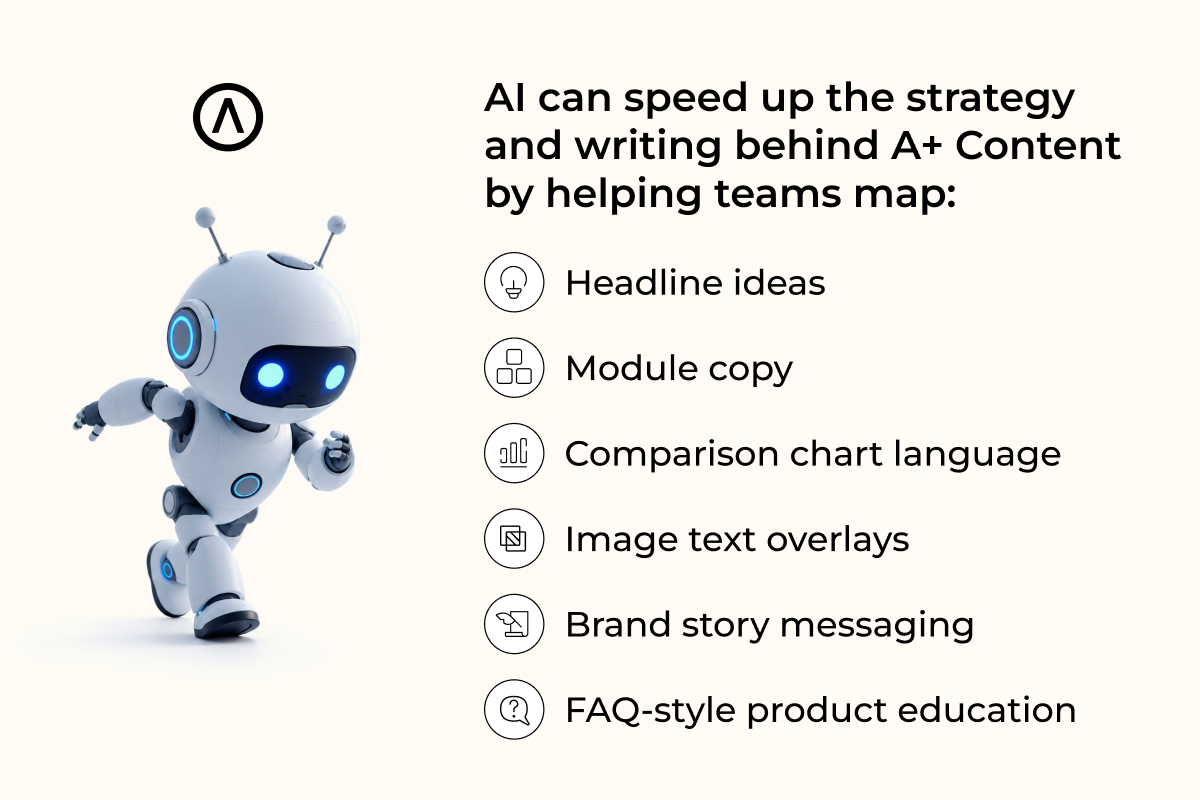
This is especially useful for brands launching a product line, not just one product. Once you define your positioning framework, AI can help adapt it across multiple ASINs without rewriting everything manually each time.
That said, A+ Content should not read like it came from a machine. It should feel considered, persuasive, and human. A good process is to use AI for structure and ideation first, then bring in a strategist, designer, or Amazon specialist to shape the final version around shopper intent.
Creating Amazon ad copy in minutes
Amazon ad copy often gets less attention than listing copy, but it can have a direct impact on click-through rate and campaign efficiency. Sponsored Brands headlines, video scripts, Store spotlight messaging, and creative testing angles all need fresh ideas.
AI tools help teams generate multiple ad copy variations quickly. That matters because performance improves when you test more than one angle. Instead of debating one headline for an hour, you can generate ten, review them, and move forward with a sharper testing plan.
Useful AI ad copy tasks include:
- headline variations for Sponsored Brands
- short-form hooks for video ads
- promotional language for seasonal pushes
- messaging adapted by audience segment
- benefit-led copy for top-performing products
This is also where brand consistency becomes important. If your listing sounds polished and premium but your ad copy feels flat or inconsistent, the customer notices. AI can help keep messaging aligned across touchpoints when your prompts include clear voice guidelines.
Best practices for scaling Amazon content with AI
If you want reliable results, build a simple system around the tool.
Start with a content brief template. Include product facts, brand voice notes, audience context, keyword targets, claims guidance, and examples of copy that already performs well. This gives ChatGPT a real foundation.
Next, create prompt frameworks for each asset type. One for listings. One for A+ Content. One for ad copy. One for creative briefs. Reusing strong prompts saves time and keeps outputs more consistent.
Then add human review. Always. AI can speed up execution, but it should not be the final approver for compliance, differentiation, or conversion quality.
For brands scaling across Amazon and D2C at the same time, this kind of workflow is even more valuable. It supports faster launches, cleaner collaboration, and a more connected content system across channels. That is often the difference between simply producing more content and producing content that actually performs. Algofy’s approach to growth reflects that broader view: combining AI, strategy, creative, and execution across the funnel so brands can move faster without losing clarity.
FAQs
Can ChatGPT write Amazon listings?
Yes. ChatGPT can create first drafts for Amazon titles, bullet points, descriptions, and keyword groupings. The best results come from detailed prompts and human editing before publishing.
Is AI-generated A+ Content effective?
It can be very effective for outlining modules, drafting copy, and speeding up production. Final edits should still be handled by someone who understands conversion strategy and brand positioning.
Can AI help with Amazon PPC ad copy?
Yes. AI can generate multiple headline and messaging variations for Sponsored Brands, video ads, and promotional campaigns. This helps teams test ideas faster.
What are the risks of using AI for Amazon content?
The main risks are generic language, inaccurate claims, compliance issues, and weak differentiation. A review process solves most of that.
Who benefits most from AI-powered Amazon content creation?
New brand owners, growing D2C teams, ecommerce managers with many listings, and agencies managing multiple client accounts tend to see the biggest gains.
Conclusion
ChatGPT and AI tools can absolutely help scale Amazon content creation. They make listings faster to draft, A+ Content easier to organize, and ad copy quicker to test. More importantly, they give growing brands a way to reduce manual workload without slowing down launches.
Still, the strongest results come from pairing AI speed with human judgment. That is where better messaging, cleaner brand alignment, and higher-converting content start to happen.
If your brand is trying to scale Amazon content without adding more chaos to the process, it helps to have a system that combines automation with strategy. Book a call with our team to build Amazon content that moves faster and performs better.