

June 1, 2026

Google Marketing Live 2026: What Ecommerce Brands Need to Know About Google’s AI-First Future

Strategy

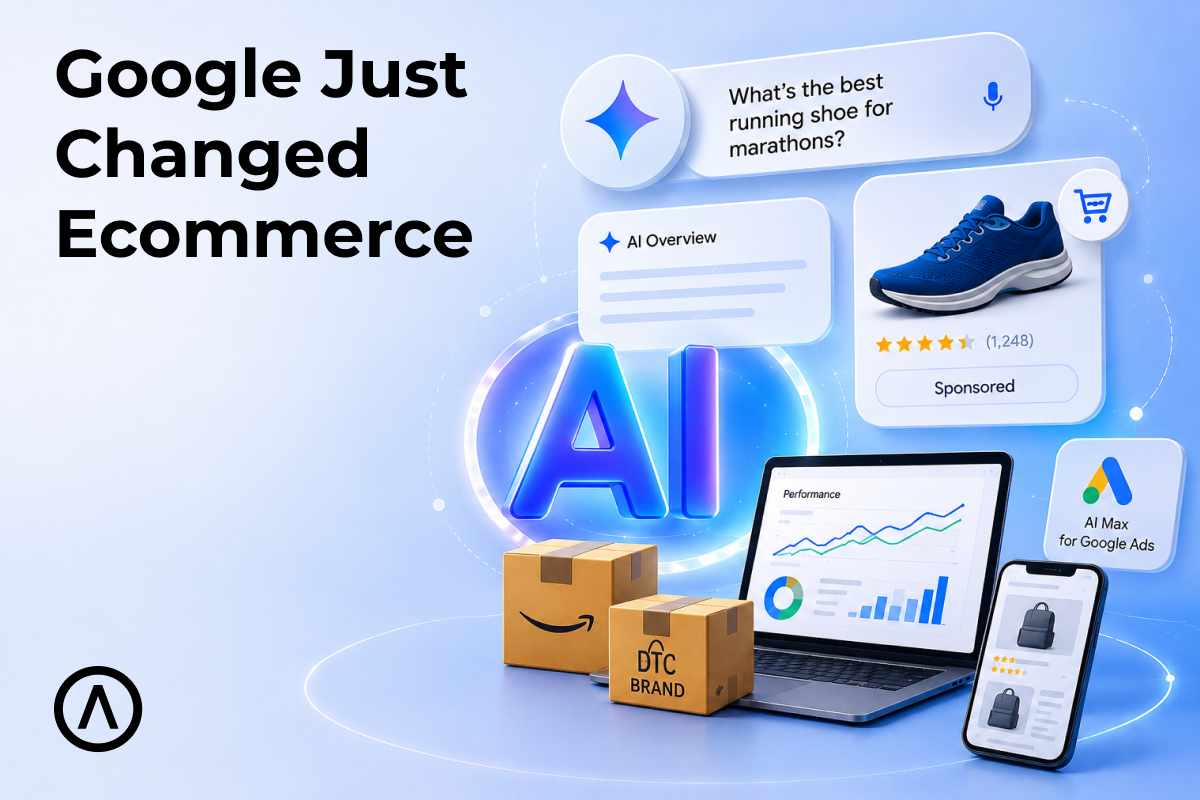
Google Marketing Live 2026 (GML 2026) made one thing very clear: AI is no longer just a feature inside Google Ads. It’s becoming the foundation of how people search, shop, discover products, and interact with brands online.

For ecommerce brands, especially those selling across Amazon and DTC channels, this shift matters more than ever.

Google introduced a wave of updates focused on:

In simple terms, Google is building a future where AI helps consumers discover products, compare options, and even make purchasing decisions faster.

For brands, this means the traditional playbook is changing.

Here’s what ecommerce brands should pay attention to from GML 2026 and what it means for your growth strategy moving forward.

Key Takeaways

  • AI-powered search is reshaping product discovery. Google is expanding conversational search experiences where AI-generated answers and product recommendations influence buying decisions.
  • Campaign automation is accelerating. New AI-driven optimization tools can manage bidding, targeting, budgets, and personalization in real time, making strategy and data quality more important than ever.
  • Agentic commerce is changing online shopping. AI assistants are helping consumers discover, compare, and evaluate products, increasing the importance of structured product content and clear messaging.
  • AI-generated creative is scaling faster. Brands can produce and test more ad variations, videos, and personalized assets, but strong positioning and creative strategy remain critical.
  • Measurement is moving beyond last-click attribution. Cross-channel visibility, incrementality, and AI-powered insights are becoming essential for understanding ecommerce performance.
  • Brands that unify Amazon and DTC strategies will have an advantage. Connected data, creative, media, and customer experiences are becoming key drivers of growth in an AI-first marketing landscape.

1. AI Search Is Changing How Customers Discover Products

One of the biggest announcements from GML 2026 was the expansion of ads inside Google’s AI-powered search experiences.

Instead of users typing short keyword searches and scrolling through blue links, Google is moving toward conversational search powered by Gemini AI.

For example, instead of searching: “best hiking backpack

Users may ask: “What’s the best waterproof hiking backpack for a 3-day mountain trip?

Google’s AI then generates a conversational answer, product recommendations, and integrated ad placements.

This is a major evolution in how ecommerce brands get discovered.

The future of visibility is no longer just about keyword rankings, bid adjustments, and basic product feeds. Instead, it's about helping AI systems understand your products, your positioning, your customers' intent, and what makes your brand relevant. Brands that provide clear, comprehensive product information and strong contextual signals will be better positioned to appear in AI-driven search and shopping experiences.

Brands with strong product data, optimized content, high-quality creatives, and connected channel strategies will have a significant advantage.

2. Google Is Automating More of Campaign Management

Another major theme from GML 2026 was automation.

Google introduced updates to AI Max campaigns and smarter optimization tools that use Gemini to:

  • adjust bids in real time
  • personalize ad delivery
  • optimize targeting
  • predict customer intent
  • allocate budget dynamically

This doesn’t mean strategy disappears. It means brands need better strategy upstream.

As automation increases, ecommerce brands need:

  • stronger creative direction
  • better audience data
  • cleaner conversion tracking
  • clearer profitability goals

AI can optimize campaigns, but it still needs high-quality inputs.

This is why siloed marketing approaches are becoming less effective.

Your Amazon strategy, Meta campaigns, Google Ads, email flows, landing pages, and creative assets all need to work together as one connected system.

At Algofy, we help brands unify these channels into a performance-focused ecosystem that improves efficiency and drives measurable growth.

3. AI-Powered Shopping Is Becoming the New Ecommerce Experience

Google also introduced several updates tied to “agentic commerce.”

This concept refers to AI-assisted shopping experiences where technology helps users discover products, compare options, evaluate features, receive personalized recommendations, and ultimately make purchasing decisions more efficiently.

In many ways, AI is becoming the new shopping assistant.

For ecommerce brands, this changes how product content should be structured.

Strong product pages are no longer only designed for human shoppers. They also need to help AI systems understand:

  • benefits
  • specifications
  • differentiators
  • use cases
  • customer intent

This makes high-quality product content increasingly important across:

  • Amazon listings
  • A+ Content
  • storefronts
  • DTC landing pages
  • SEO pages
  • structured product data

Brands that invest in content clarity and conversion-focused experiences will be better positioned for the next generation of search and shopping.

4. Creative Production Is Accelerating With AI

Creative fatigue continues to be one of the biggest challenges in ecommerce advertising.

At GML 2026, Google announced expanded AI creative capabilities that allow brands to generate:

  • ad variations
  • visual assets
  • video creatives
  • personalized messaging
  • audience-specific adaptations

The speed of creative testing is increasing rapidly.

But while AI can accelerate production, strategy still matters.

The best-performing ecommerce brands are not simply generating more creatives. They’re building:

  • stronger brand positioning
  • better customer messaging
  • platform-specific creative strategies
  • full-funnel storytelling

This is especially important across Amazon and DTC ecosystems where customer journeys often span multiple touchpoints before conversion.

Brands need creative systems that: prevent ad fatigue, improve click-through rates, increase conversion rates, and align messaging across platforms.

5. Measurement and Attribution Are Evolving

Privacy changes and fragmented customer journeys continue to make attribution more complex.

Google addressed this heavily at GML 2026 through updates focused on:

  • modeled attribution
  • incrementality
  • AI-powered measurement
  • cross-channel insights
  • conversion quality

For ecommerce brands, this reinforces an important reality:

Last-click attribution is no longer enough.

Brands need a clearer understanding of how channels work together across the entire customer journey.

For example:

  • Amazon ads may increase branded search demand
  • Meta campaigns may improve Google conversion rates
  • YouTube may influence high-intent traffic later in the funnel
  • Email retention may improve ROAS across paid channels

Without connected measurement systems, brands risk making optimization decisions based on incomplete data.

This is why full-funnel visibility is becoming essential for scalable ecommerce growth.

6. What Ecommerce Brands Should Do Next

GML 2026 wasn’t just about new features. It was Google signaling where ecommerce marketing is headed over the next few years. The brands that adapt early will likely gain an advantage as AI-driven discovery and automation continue to expand.

To prepare, brands should focus on strengthening product content across Amazon and DTC channels, ensuring listings, product pages, and structured data clearly communicate value to both shoppers and AI systems.

It's also becoming increasingly important to unify Amazon and DTC strategies. Paid media, SEO, email, creative, and ecommerce experiences should work together as one connected ecosystem rather than operating in silos.

As AI makes creative production faster and more accessible, brands should prioritize differentiated messaging, platform-native creative, and consistent testing to identify what drives performance.

Finally, investing in first-party data and accurate measurement will be critical. Brands with stronger audience signals, cleaner tracking, and a better understanding of customer behavior will be better positioned to capitalize on AI-powered optimization and outperform competitors.

FAQs

1. What is Google Marketing Live (GML)?

Google Marketing Live is Google’s annual event where the company announces major updates across Google Ads, Search, YouTube, Shopping, Analytics, and AI-powered marketing tools. GML 2026 focused heavily on AI-driven advertising and ecommerce experiences.

2. Why is GML 2026 important for ecommerce brands?

GML 2026 introduced major AI-powered updates that will impact how customers search, shop, and discover products online. Ecommerce brands need to adapt to conversational search, automated campaign optimization, AI-powered shopping experiences, and evolving attribution models.

3. What are AI-powered shopping experiences?

AI-powered shopping experiences use tools like Gemini to help customers discover products, compare options, receive recommendations, and make purchase decisions faster. This shift means brands need stronger product content, optimized listings, and connected customer journeys.

4. How will AI change Google Ads campaigns?

Google is increasing automation across campaign management with tools that optimize bids, targeting, budgets, and ad delivery in real time. Brands will need better creative strategies, cleaner data, and full-funnel marketing systems to maximize performance.

5. How can ecommerce brands prepare for the future of AI-driven marketing?

Brands should focus on improving product content, strengthening Amazon and DTC integration, investing in creative testing, optimizing conversion tracking, and building unified full-funnel marketing strategies that support AI-powered discovery and shopping experiences.

The Bottom Line

Google Marketing Live 2026 confirmed that ecommerce marketing is entering a new AI-first era. Search is becoming conversational. Shopping is becoming AI-assisted. Campaigns are becoming increasingly automated. Creative production is accelerating. And measurement is evolving beyond last-click attribution.

For ecommerce brands, the opportunity is significant, but only for teams prepared to adapt quickly. If you're looking to future-proof your ecommerce strategy and capitalize on the opportunities emerging from Google's AI-first ecosystem, book a free growth strategy call with Algofy. Our team can help you identify performance gaps, uncover new growth opportunities, and build a roadmap for sustainable, profitable growth across Amazon and DTC channels.

 Check out our job openings here
Contact Us

Google Marketing Live 2026: What Ecommerce Brands Need to Know About Google’s AI-First Future

June 1, 2026

Google Marketing Live 2026 (GML 2026) made one thing very clear: AI is no longer just a feature inside Google Ads. It’s becoming the foundation of how people search, shop, discover products, and interact with brands online.

For ecommerce brands, especially those selling across Amazon and DTC channels, this shift matters more than ever.

Google introduced a wave of updates focused on:

In simple terms, Google is building a future where AI helps consumers discover products, compare options, and even make purchasing decisions faster.

For brands, this means the traditional playbook is changing.

Here’s what ecommerce brands should pay attention to from GML 2026 and what it means for your growth strategy moving forward.

Key Takeaways

  • AI-powered search is reshaping product discovery. Google is expanding conversational search experiences where AI-generated answers and product recommendations influence buying decisions.
  • Campaign automation is accelerating. New AI-driven optimization tools can manage bidding, targeting, budgets, and personalization in real time, making strategy and data quality more important than ever.
  • Agentic commerce is changing online shopping. AI assistants are helping consumers discover, compare, and evaluate products, increasing the importance of structured product content and clear messaging.
  • AI-generated creative is scaling faster. Brands can produce and test more ad variations, videos, and personalized assets, but strong positioning and creative strategy remain critical.
  • Measurement is moving beyond last-click attribution. Cross-channel visibility, incrementality, and AI-powered insights are becoming essential for understanding ecommerce performance.
  • Brands that unify Amazon and DTC strategies will have an advantage. Connected data, creative, media, and customer experiences are becoming key drivers of growth in an AI-first marketing landscape.

1. AI Search Is Changing How Customers Discover Products

One of the biggest announcements from GML 2026 was the expansion of ads inside Google’s AI-powered search experiences.

Instead of users typing short keyword searches and scrolling through blue links, Google is moving toward conversational search powered by Gemini AI.

For example, instead of searching: “best hiking backpack

Users may ask: “What’s the best waterproof hiking backpack for a 3-day mountain trip?

Google’s AI then generates a conversational answer, product recommendations, and integrated ad placements.

This is a major evolution in how ecommerce brands get discovered.

The future of visibility is no longer just about keyword rankings, bid adjustments, and basic product feeds. Instead, it's about helping AI systems understand your products, your positioning, your customers' intent, and what makes your brand relevant. Brands that provide clear, comprehensive product information and strong contextual signals will be better positioned to appear in AI-driven search and shopping experiences.

Brands with strong product data, optimized content, high-quality creatives, and connected channel strategies will have a significant advantage.

2. Google Is Automating More of Campaign Management

Another major theme from GML 2026 was automation.

Google introduced updates to AI Max campaigns and smarter optimization tools that use Gemini to:

  • adjust bids in real time
  • personalize ad delivery
  • optimize targeting
  • predict customer intent
  • allocate budget dynamically

This doesn’t mean strategy disappears. It means brands need better strategy upstream.

As automation increases, ecommerce brands need:

  • stronger creative direction
  • better audience data
  • cleaner conversion tracking
  • clearer profitability goals

AI can optimize campaigns, but it still needs high-quality inputs.

This is why siloed marketing approaches are becoming less effective.

Your Amazon strategy, Meta campaigns, Google Ads, email flows, landing pages, and creative assets all need to work together as one connected system.

At Algofy, we help brands unify these channels into a performance-focused ecosystem that improves efficiency and drives measurable growth.

3. AI-Powered Shopping Is Becoming the New Ecommerce Experience

Google also introduced several updates tied to “agentic commerce.”

This concept refers to AI-assisted shopping experiences where technology helps users discover products, compare options, evaluate features, receive personalized recommendations, and ultimately make purchasing decisions more efficiently.

In many ways, AI is becoming the new shopping assistant.

For ecommerce brands, this changes how product content should be structured.

Strong product pages are no longer only designed for human shoppers. They also need to help AI systems understand:

  • benefits
  • specifications
  • differentiators
  • use cases
  • customer intent

This makes high-quality product content increasingly important across:

  • Amazon listings
  • A+ Content
  • storefronts
  • DTC landing pages
  • SEO pages
  • structured product data

Brands that invest in content clarity and conversion-focused experiences will be better positioned for the next generation of search and shopping.

4. Creative Production Is Accelerating With AI

Creative fatigue continues to be one of the biggest challenges in ecommerce advertising.

At GML 2026, Google announced expanded AI creative capabilities that allow brands to generate:

  • ad variations
  • visual assets
  • video creatives
  • personalized messaging
  • audience-specific adaptations

The speed of creative testing is increasing rapidly.

But while AI can accelerate production, strategy still matters.

The best-performing ecommerce brands are not simply generating more creatives. They’re building:

  • stronger brand positioning
  • better customer messaging
  • platform-specific creative strategies
  • full-funnel storytelling

This is especially important across Amazon and DTC ecosystems where customer journeys often span multiple touchpoints before conversion.

Brands need creative systems that: prevent ad fatigue, improve click-through rates, increase conversion rates, and align messaging across platforms.

5. Measurement and Attribution Are Evolving

Privacy changes and fragmented customer journeys continue to make attribution more complex.

Google addressed this heavily at GML 2026 through updates focused on:

  • modeled attribution
  • incrementality
  • AI-powered measurement
  • cross-channel insights
  • conversion quality

For ecommerce brands, this reinforces an important reality:

Last-click attribution is no longer enough.

Brands need a clearer understanding of how channels work together across the entire customer journey.

For example:

  • Amazon ads may increase branded search demand
  • Meta campaigns may improve Google conversion rates
  • YouTube may influence high-intent traffic later in the funnel
  • Email retention may improve ROAS across paid channels

Without connected measurement systems, brands risk making optimization decisions based on incomplete data.

This is why full-funnel visibility is becoming essential for scalable ecommerce growth.

6. What Ecommerce Brands Should Do Next

GML 2026 wasn’t just about new features. It was Google signaling where ecommerce marketing is headed over the next few years. The brands that adapt early will likely gain an advantage as AI-driven discovery and automation continue to expand.

To prepare, brands should focus on strengthening product content across Amazon and DTC channels, ensuring listings, product pages, and structured data clearly communicate value to both shoppers and AI systems.

It's also becoming increasingly important to unify Amazon and DTC strategies. Paid media, SEO, email, creative, and ecommerce experiences should work together as one connected ecosystem rather than operating in silos.

As AI makes creative production faster and more accessible, brands should prioritize differentiated messaging, platform-native creative, and consistent testing to identify what drives performance.

Finally, investing in first-party data and accurate measurement will be critical. Brands with stronger audience signals, cleaner tracking, and a better understanding of customer behavior will be better positioned to capitalize on AI-powered optimization and outperform competitors.

FAQs

1. What is Google Marketing Live (GML)?

Google Marketing Live is Google’s annual event where the company announces major updates across Google Ads, Search, YouTube, Shopping, Analytics, and AI-powered marketing tools. GML 2026 focused heavily on AI-driven advertising and ecommerce experiences.

2. Why is GML 2026 important for ecommerce brands?

GML 2026 introduced major AI-powered updates that will impact how customers search, shop, and discover products online. Ecommerce brands need to adapt to conversational search, automated campaign optimization, AI-powered shopping experiences, and evolving attribution models.

3. What are AI-powered shopping experiences?

AI-powered shopping experiences use tools like Gemini to help customers discover products, compare options, receive recommendations, and make purchase decisions faster. This shift means brands need stronger product content, optimized listings, and connected customer journeys.

4. How will AI change Google Ads campaigns?

Google is increasing automation across campaign management with tools that optimize bids, targeting, budgets, and ad delivery in real time. Brands will need better creative strategies, cleaner data, and full-funnel marketing systems to maximize performance.

5. How can ecommerce brands prepare for the future of AI-driven marketing?

Brands should focus on improving product content, strengthening Amazon and DTC integration, investing in creative testing, optimizing conversion tracking, and building unified full-funnel marketing strategies that support AI-powered discovery and shopping experiences.

The Bottom Line

Google Marketing Live 2026 confirmed that ecommerce marketing is entering a new AI-first era. Search is becoming conversational. Shopping is becoming AI-assisted. Campaigns are becoming increasingly automated. Creative production is accelerating. And measurement is evolving beyond last-click attribution.

For ecommerce brands, the opportunity is significant, but only for teams prepared to adapt quickly. If you're looking to future-proof your ecommerce strategy and capitalize on the opportunities emerging from Google's AI-first ecosystem, book a free growth strategy call with Algofy. Our team can help you identify performance gaps, uncover new growth opportunities, and build a roadmap for sustainable, profitable growth across Amazon and DTC channels.

Related articles

article

Google Marketing Live 2026: What Ecommerce Brands Need to Know About Google’s AI-First Future

article

GEO vs SEO: How Amazon Brands Can Optimize for AI-Powered Search Engines Like ChatGPT, Perplexity and Google AI Overviews in 2026

article

AI-Powered PPC Bid Management for Q2: How to Automate Amazon Ads and Cut ACoS by 30%